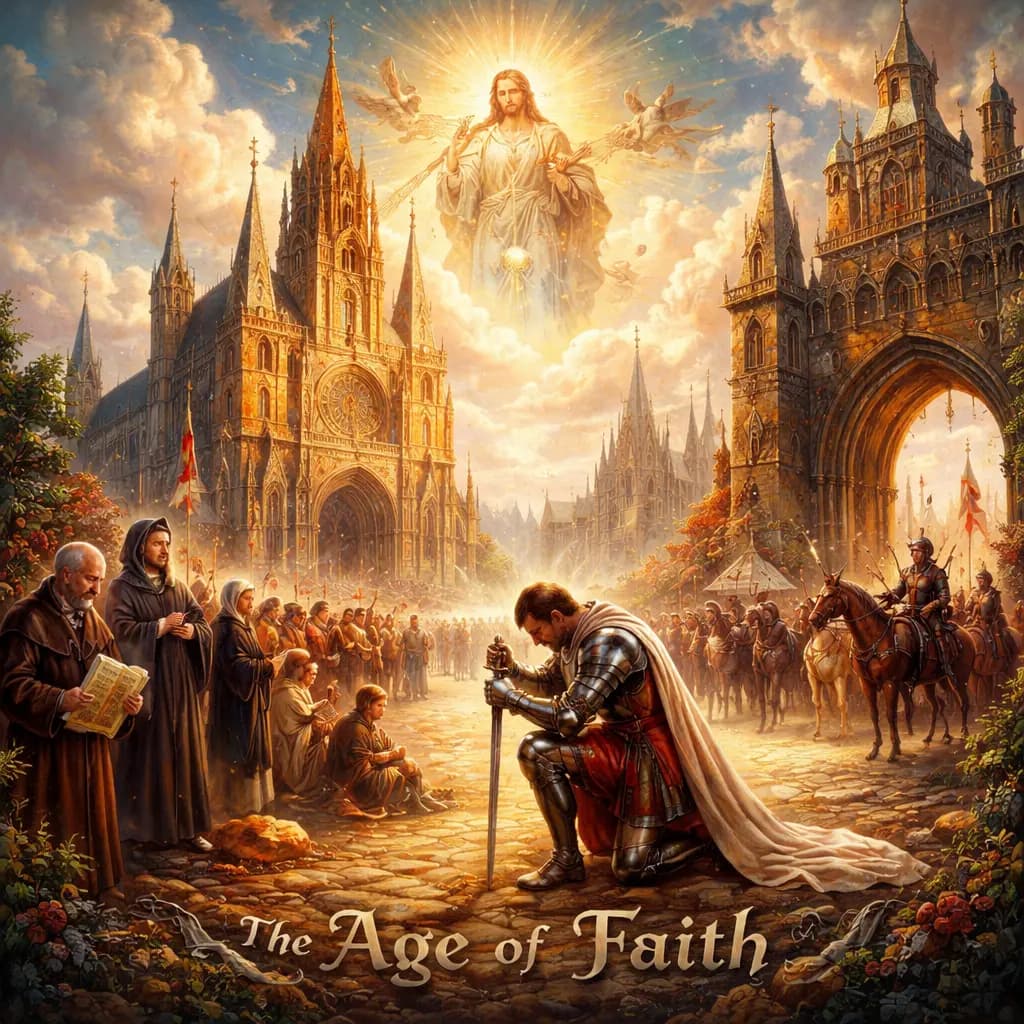
It begins with the expansion of major religions, especially Christianity and Islam; reaches its peak in the Middle Ages with the rise of the Church, theology, and religious institutions
Will Durant recounts the last major attempt to revive paganism in the Roman Empire through Julian, nephew of Constantine. After Constantine's death, the empire was divided among his sons, leading to civil war. Julian, raised as a Christian, turned to paganism in his youth. Appointed Caesar of Gaul, he defeated the Germans and restored the province. In 360 he was proclaimed emperor and sought to restore paganism: reopening temples, cutting state support for the Church, and organizing a "church" of paganism. He waged war against Persia but was killed in 363. His death ended the final serious effort to restore the old religion and accelerated Christianity's complete victory.
A detailed examination of the internal and external factors that led to the fall of the Western Roman Empire between 325 and 476 AD. This article analyzes the threatened borders, the role of barbarian invasions by Goths, Vandals, and Huns, the efforts of saving emperors, the economic and social decline of Italy, and the successive sacks of Rome, based on Will Durant’s historical narrative.
A comprehensive historical analysis of the rise and consolidation of Christianity from 364 to 451 AD, covering the remarkable organization of the Church, major heresies, the role of key Church Fathers in the West and East, the profound influence of Saint Augustine, and how Christianity shaped morality, society, and culture during the declining Western Roman Empire.
A comprehensive historical analysis of how Europe began to take shape during the transition from the Western Roman Empire to the Middle Ages, from 325 to 529 AD. This article examines the transformation of Britain into England, the situation in Ireland, the prelude to France with the Franks and the Merovingian dynasty, Visigothic Spain, and Ostrogothic Italy under Theodoric and Boethius, showing how barbarian invasions, Christianity, and new institutions laid the foundations of medieval European civilization.
A comprehensive historical examination of the reign of Emperor Justinian I from 527 to 565 AD, covering his efforts to restore the Roman Empire, his major wars of reconquest led by Belisarius, the codification of Roman law, his theological controversies, the influence of Empress Theodora, and the long-term consequences of his ambitious policies on the Byzantine Empire and medieval Europe.
A comprehensive examination of Byzantine civilization from 326 to 565 AD, covering its dynamic economy blending private investment, state oversight, and nationalized industries; advances in science and philosophy; historical and religious literature; and the flourishing of Byzantine art in architecture, mosaics, illumination, music, and crafts. The article shows how Byzantium, by preserving Roman heritage and absorbing Eastern elements, laid the foundations of medieval European and Middle Eastern civilization.
A comprehensive study of the Sassanid Empire from 224 to 641 AD, covering its society, culture, economy, religion, kingship, art, and the dramatic fall to the Arab conquest. The article explores how the Sassanids revived Persian glory after the Parthians, restored Zoroastrianism, created a powerful centralized state, fostered remarkable art and scholarship, and ultimately succumbed to internal weaknesses and the rising force of Islam, leaving a lasting legacy on Iranian and Islamic civilization.
A comprehensive examination of the life of Prophet Muhammad (PBUH) from 570 to 632 AD, covering his childhood and youth in Mecca, the beginning of revelation and preaching, the Hijra to Medina, the establishment of the Islamic state, wars and peaces, the conquest of Mecca, and the final years of his life. The article shows how the Prophet (PBUH) transformed from an orphaned poor boy into the leader of a united nation, founded Islam, revolutionized Arab ethics and culture, and left an eternal legacy for humanity.
Between the 7th and 656th years of the Hijri calendar (628-1058 AD), Islamic countries experienced significant economic growth in agriculture, industry, and trade. Regular irrigation systems, introduction of new crops such as orange, sugarcane, and cotton, mining activities, and extensive commerce reaching China and Europe created a powerful economy. Alongside this, Islamic faith with its five pillars shaped daily life, while a theocratic government with advanced administrative systems turned cities like Baghdad and Damascus into centers of civilization.
From the 11th to the 450th year of the Hijri calendar (632-1058 AD), the eastern provinces of the Islamic world experienced a remarkable flourishing of scholarship, sciences, philosophy, literature, and arts. Education began in childhood with Quran memorization and advanced in mosques and schools across vast territories. Extensive translation movements brought Greek, Persian, and Indian knowledge into Arabic, leading to breakthroughs in mathematics, astronomy, medicine, and philosophy. Historians, poets, Sufis, and artists created enduring works that blended diverse cultural influences, while architecture, calligraphy, ceramics, and music reached high levels of refinement and beauty.
From 21 to 479 AH (641-1086 AD), North Africa and Spain (al-Andalus) came under Muslim rule. The conquest of Egypt by Amr ibn al-As and expansion into Tunisia, Morocco, and Spain created a powerful Islamic civilization. The Umayyad caliphs of Spain, the Fatimids of Egypt, and local emirs elevated scientific, artistic, and commercial centers such as Cordoba, Cairo, and Kairouan to their peak, producing a flourishing civilization with magnificent mosques, advanced sciences, and rich literature that lasted until the Almoravid invasion.
Between 450 and 656 AH (1058–1258 AD), the eastern Islamic world experienced the rise of the Seljuk sultans, the challenges of the Crusades, and the devastating Mongol invasion. Alp Arslan and Malik Shah, supported by their capable vizier Nizam al-Mulk, restored prosperity and order. After Sanjar’s death the Seljuk state fragmented into small emirates. In the west, the Almoravids and Almohads ruled North Africa and al-Andalus, but internal strife and Christian advances led to gradual decline. Despite political weakening, poetry, science, philosophy, and especially architecture and the arts continued to flourish during this period of relative decline.
