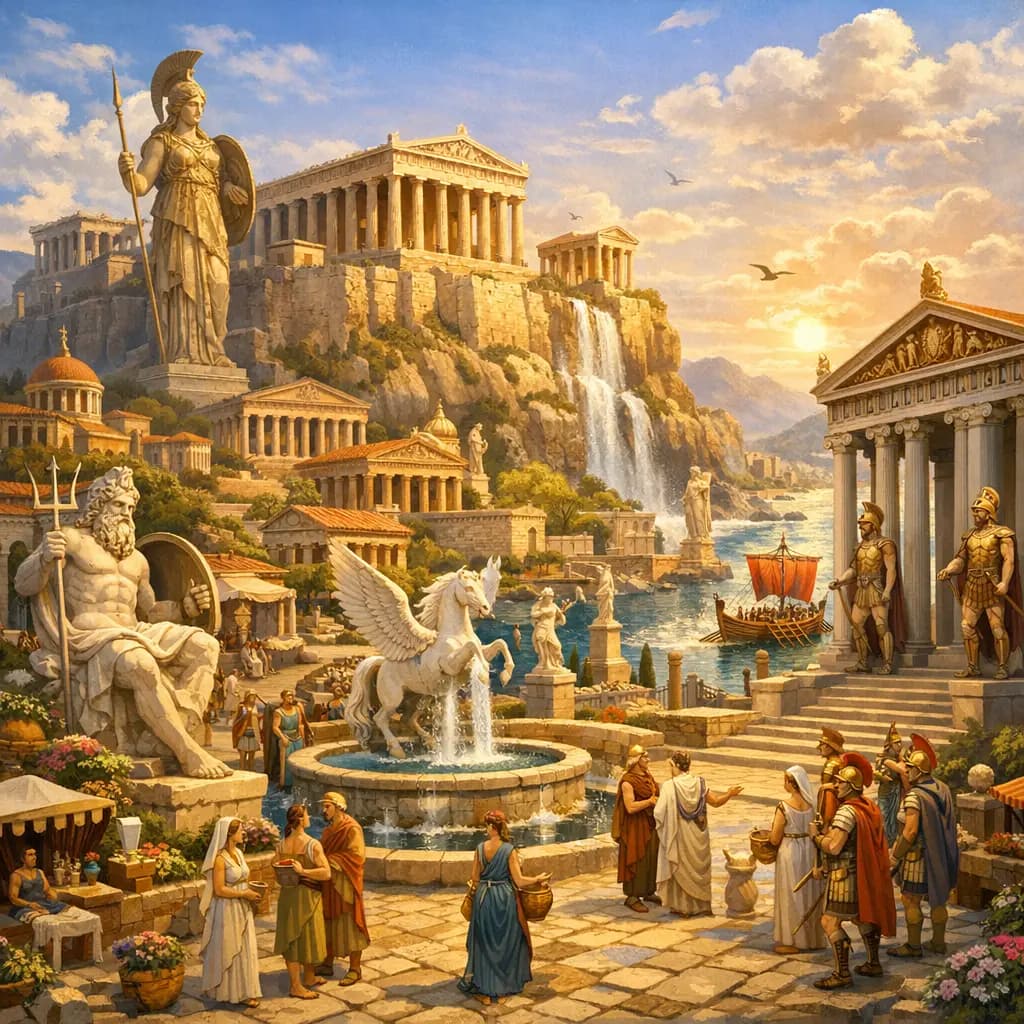
The history of Greece began with ancient city-states like Athens and Sparta
This article explores the relationship between Alexander the Great and his teacher Aristotle, Alexander’s personality and ambitions, his vast conquests, and his policy of cultural fusion between Greeks and Eastern peoples. It also examines the final years of Alexander’s life, his sudden death, and the fragmentation of his empire. The article concludes with an overview of the Hellenistic era and the social, political, and economic challenges of Sparta during this period. Together, these themes illustrate how Alexander reshaped the ancient world and how his legacy transformed Greek civilization into a global cultural force.
This article examines the Seleucid Empire—one of the largest successor states of Alexander the Great—and its role in spreading Hellenistic culture across Asia. It also explores the Kingdom of Pergamon as a major cultural, artistic, and political center of the Hellenistic era. Together, these states shaped a new world where Greek culture blended with Eastern traditions, creating one of the most influential cultural periods in ancient history.
This article examines the rise of the Ptolemaic dynasty in Egypt after the death of Alexander the Great, focusing on Ptolemy I’s consolidation of power, the cultural and scientific flourishing of Alexandria, and the gradual decline of the dynasty. It also provides a concise explanation of the role of government in socialism and concludes with an overview of Alexandria’s decline from a global intellectual center to a weakened city affected by wars and foreign intervention.
This article explores the rise of the Library of Alexandria and its associated research institution, the Museum, during the Ptolemaic period. Supported by the early Ptolemaic kings, Alexandria became the greatest scientific and cultural center of the ancient world. The article highlights the work of major scholars such as Euclid, Archimedes, Eratosthenes, and Galen, examines the scientific methods used in Alexandria, and explains the gradual decline of the library due to wars, political instability, and reduced royal support.
This article examines two major themes from Will Durant’s History of Civilization: the transformation of art during the Hellenistic decline and the extraordinary scientific achievements of the same era. While art shifted from classical balance to emotional excess and dramatic realism, science reached unprecedented heights in centers like Alexandria. The article explores these contrasting developments and highlights the cultural complexity of the Hellenistic world.
This article, based on Chapter Twenty-Nine of Will Durant’s History of Civilization, examines the transformation of philosophy during the Hellenistic era. After the collapse of the Greek city-states and the rise of Alexander’s empire, people turned away from politics and toward personal peace, emotional stability, and practical ethics. Three major schools—Epicureanism, Stoicism, and Skepticism—offered different paths to inner tranquility. The article explains how philosophy shifted from theoretical inquiry to a guide for living.
This article, based on Chapter Thirty of Will Durant’s History of Civilization, examines the early rise of Rome from a small Italian city-state to a growing Mediterranean power. It focuses on Rome’s first major encounter with the Greek world through its war with Pyrrhus of Epirus. The conflict demonstrated Rome’s discipline, resilience, and military determination, while introducing the famous concept of a “Pyrrhic victory.” The article highlights the historical significance of this turning point, which marked the beginning of Rome’s expansion into a dominant imperial force.
The Aegean islands—from the Cyclades to Cyprus and Troy—formed one of the most influential foundations for pre‑classical civilizations. Their natural resources, strategic geography, and maritime connections shaped trade routes, metal industries, and local cultures. Archaeological excavations since the late nineteenth century have revealed a clear picture of Cycladic civilization, Cypriot culture, and the multiple settlement layers of Troy. This article examines the geographical importance of these islands, their cultural evolution, metalworking industries, and the archaeological discoveries associated with them.
