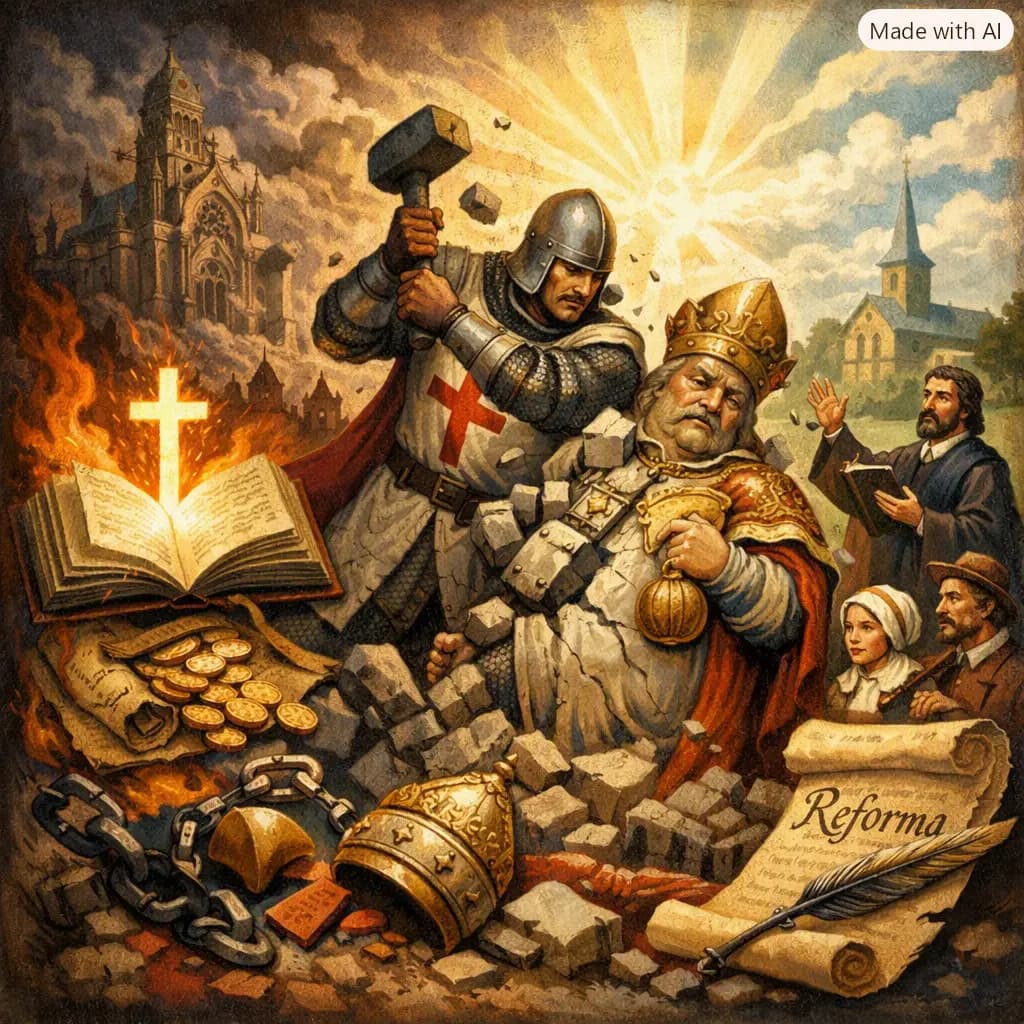
A period in European history marked by efforts to reform the Christian Church
A retelling of Durant's account of how a timid king, helped by a mother-in-law, a mistress, a merchant-financier and a new standing army, drove the English out of France and ended the Hundred Years' War.
A retelling of Durant's portrait of Louis XI: a plain, suspicious, ruthless and pious king who beat the great barons and Burgundy with diplomacy, spies and money, and left France more united, richer and more centralized.
A retelling of Durant's account of France after Louis XI: a wise regent, a teenage king's march on Naples, the chivalry of Bayard, and the popular reign of Louis XII, "Father of the People," whose Italian wars ended in failure.
A retelling of Durant's survey of French art at the turn of the sixteenth century: late Gothic churches, grand civic halls, Italian-inspired Loire châteaux, and the sculptors, painters and craftsmen who blended Gothic, Flemish and Renaissance styles.
A retelling of Durant's account of French literature in an age of chaos: Philippe de Commynes, the first philosophical historian; the popular stage with its mysteries, farces and sotties; and the thief-poet François Villon, whose wit and laments outlived his crimes.
A retelling of Durant's account of fifteenth-century English kingship: rebellion under Henry IV, the glory of Henry V, the madness of Henry VI, thirty-one years of civil war, and the calculating rule of Henry VII, who left England orderly and solvent.
A retelling of Durant's account of England's economic rise: the decline of serfdom, the sheep that displaced farmers, the first merchant companies, the voyages of John Cabot, Henry VII's labor rules, and Jack Cade's rising of 1450.
A retelling of Durant's portrait of English daily life around 1500: blunt speech and arranged marriages, lawlessness and corruption, manor houses and meals, clothing, games, hazardous travel, harsh punishment, and Sir John Fortescue's defense of English law.
A retelling of Durant's account of English dissent in the fifteenth century: the Church's recovery after Wycliffe, the Lollards' demands, the law for burning heretics, Sir John Oldcastle's revolt, the quiet persistence of the movement, and Bishop Reginald Pecock's appeal to reason.
A retelling of Durant's survey of English art in the late Middle Ages: the Decorated and Perpendicular styles, timber roofs and fan vaults, Westminster, Windsor, Oxford, Eton and King's College Chapel, and the more modest achievements of English sculpture, woodcarving and illumination.
A retelling of Durant's account of English letters before the Tudors: the morality play Everyman, William Caxton's first printing press at Westminster, Sir Thomas Malory's Morte d'Arthur, and the tender voices in the Paston family letters.
A retelling of Durant's account of how Italian learning reached England: scholars who studied in Florence and Padua, the Oxford movement for Greek, Thomas Linacre's medicine, and John Colet's call for a purified, Bible-centered Church.
