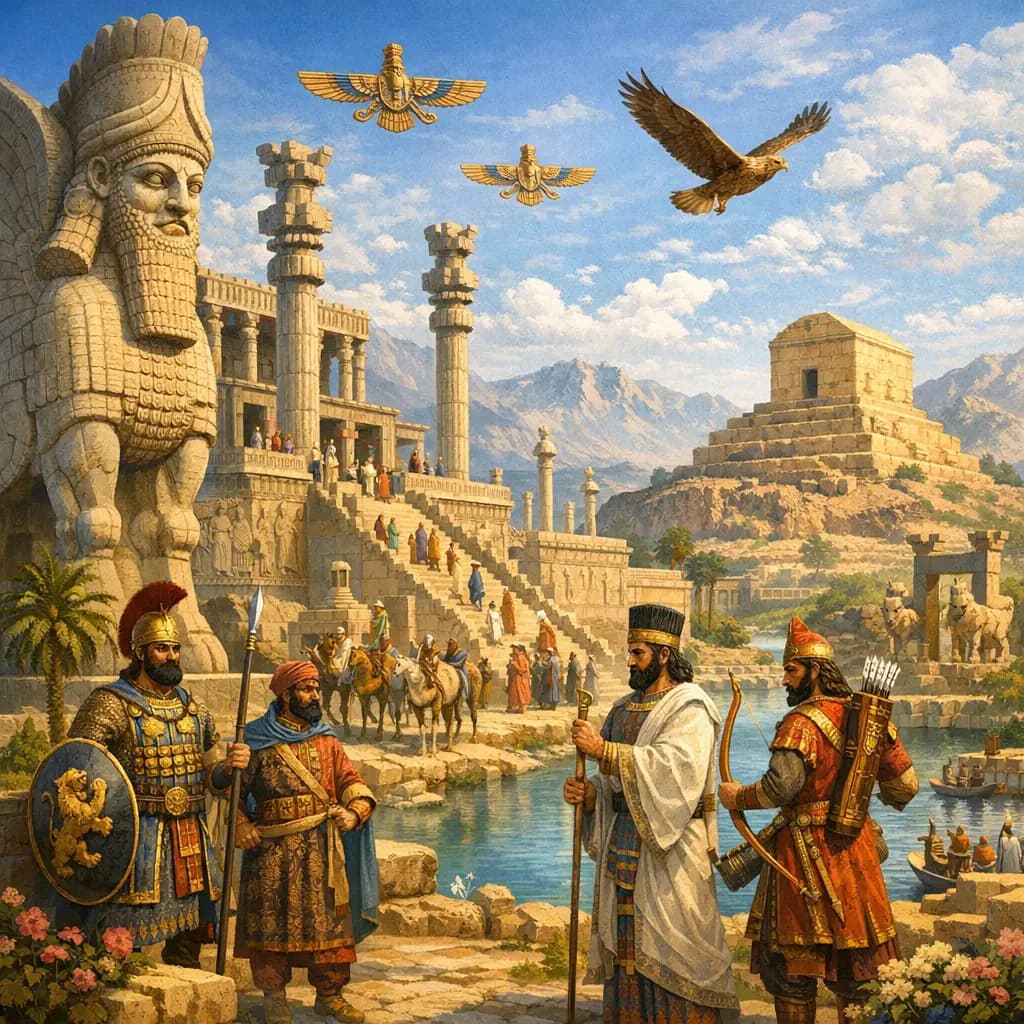
The land of Iran began in ancient times with early kingdoms
The term “Aryan” originally referred to a linguistic and cultural group within the Indo‑European family, specifically the Indo‑Iranian branch. Found in ancient Iranian and Indian texts, the word meant “noble” or “honorable” and had no racial meaning. This article explores the origins of the term, the peoples associated with it, their migrations, and the modern misunderstandings that have surrounded the concept.
The legendary kings of ancient Iran—from Keyumars to the end of the Kayanian dynasty—form the mythological foundation of Iranian cultural identity. These figures, preserved in the Avesta, Middle Persian texts, and Ferdowsi’s Shahnameh, represent the evolution of civilization, kingship, ethics, and cosmic struggle in Iranian thought. This article explores each ruler’s role, symbolism, and contributions within the broader Indo‑Iranian mythological tradition.
Sistan—known historically as Sakastan or Sakasthana—was the homeland of the Saka (Scythian) tribes in eastern Iran. The region played a major role in Iranian mythology, Zoroastrian tradition, and later Persian epic literature. This article explores the origins of the name, the Scythian presence, the cultural identity of Sistan, and its significance in Iranian history.
The Iranian peoples known as Pars, Parthia, and Media were three foundational branches of the Indo‑Iranian migrations that settled across the Iranian Plateau during the first millennium BCE. Each group established a major political structure—Median, Achaemenid, and Arsacid—that shaped the political, linguistic, and cultural identity of ancient Iran. This article provides a comparative overview of their origins, territories, political systems, and historical roles.
Jamshid—known in the Avesta as Yima or Yima Xšaēta—is one of the most influential mythological figures in Iranian tradition. His story spans ancient Indo‑Iranian mythology, Zoroastrian cosmology, and later Persian epic literature. This article explores his origins, his role in the Avesta, the myth of the Vara, his transformation in the Shahnameh, and the cultural symbolism associated with him.
