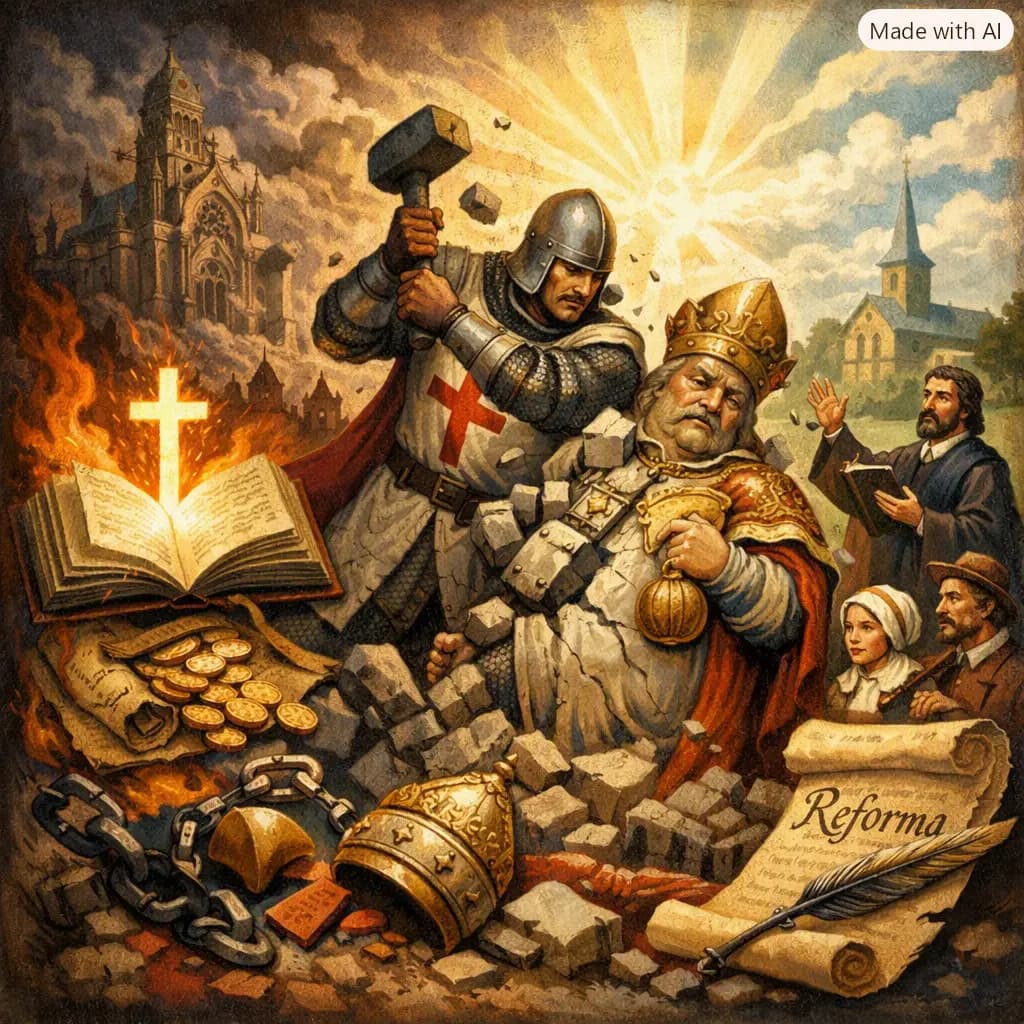
A period in European history marked by efforts to reform the Christian Church
This article traces how the Christian Church shaped European society for a thousand years by giving people meaning, moral law, education, art, and a shared international order, and how political rivalry, financial greed, and the Avignon and Western Schisms eroded that authority. It ends with the Council of Constance and the conciliar movement, which ended the schism but failed to achieve real reform.
This article follows the papacy from the end of the conciliar crisis to the eve of the Reformation. It shows how the popes recovered their authority and became great patrons of art and learning while their courts grew more worldly. It then explains the economic, political, and intellectual changes that were quietly weakening the medieval Church from outside.
This article sets out the main charges that devout Catholics themselves brought against the Church in the fourteenth and fifteenth centuries. It covers the Church's vast property, the sale of offices at Rome, the holding of several benefices by one person, the decay of monastic and clerical discipline, and the commercial abuse of indulgences. It ends with the widespread hostility toward the clergy and the repeated failure of reform from within.
This article opens the story of fourteenth-century England with the coronation oath of Edward II and the weak reign that followed. It explains how Parliament took shape as a two-house assembly with a power over money, and it describes the long, war-driven reign of Edward III. It ends with the discontent of the 1370s and the accession of the child king Richard II.
This article follows John Wycliffe from the political resentment of English rulers toward papal taxation to his theology of predestination, his attack on clerical wealth, and his rejection of transubstantiation. It describes his protection by John of Gaunt, the trials he survived, the founding of the Lollard preachers, and the English Bible translation. It ends with his death, the posthumous burning of his remains at Constance, and the many ideas he passed on to later reformers.
This article describes the English society that produced the Great Revolt of 1381, from its class divisions and growing cloth industry to the Black Death and the failed attempts to freeze wages. It follows the rising from the poll tax riots in Essex and Kent through the capture of London, the killing of Archbishop Sudbury, and the death of Wat Tyler at Smithfield. It ends with the king's revocation of his promises, the executions that followed, and the refusal of Parliament to end serfdom.
This article traces how English gradually replaced French as the language of law, speech, and poetry in the fourteenth century. It covers the beginnings of English religious and secular drama, the visionary satire of Piers Plowman, and the moralizing Gower. The longest part follows the life and work of Geoffrey Chaucer, from his diplomatic career and Italian influences to Troilus and Criseyde and the Canterbury Tales.
This article first follows Richard II from his early courage and the Merciless Parliament to his tyranny, deposition, and death, which ended the Plantagenet line in 1399. It then opens the story of France around 1300, a patchwork kingdom with powerful fiefs, the rich and unruly cities of Flanders, and the mass uprising of poor peasants. It ends with the succession disputes that led Edward III to claim the French crown and begin the Hundred Years' War.
This article follows the first phase of the Hundred Years' War from the economic and political causes that led Edward III to declare war, through the naval victory at Sluys, the battle of Crécy, and the siege of Calais. It then describes the Black Death in Europe and its social effects, the English victory at Poitiers, and the French crisis that followed, including the Estates-General, Étienne Marcel, and the Jacquerie. It ends with the Treaty of Brétigny and the reconquest under Charles V and Bertrand du Guesclin.
This article follows France under the insane Charles VI, from the wave of popular revolts across Europe to Henry V's victory at Agincourt, the siege of Rouen, and the humiliating Treaty of Troyes. It describes the hunger and devastation of Paris and Normandy under Bedford's English rule. The second half surveys daily life in the ruined kingdom, covering morals, the Dance of Death, the troubled Church, Jean Gerson, fashion, and the great houses of the rich.
This article surveys French culture during the Hundred Years' War, when writers and artists kept working amid devastation. It covers biblical scholarship, the fabulous travels of the so-called John Mandeville, Froissart's Chronicle, the theater, the poetry societies, and poets such as Deschamps, Christine de Pizan, Alain Chartier, and Charles of Orléans. It then follows the move from Rayonnant to Flamboyant Gothic, the rise of secular architecture, the illuminated books of the Duke of Berry, and the painter Jean Fouquet.
A retelling of Will Durant's account of Joan of Arc: the weak king she served, the village that raised her, the relief of Orléans, the coronation at Reims, her capture and sale, and the Church trial that sent her to the stake and was reversed decades later.
