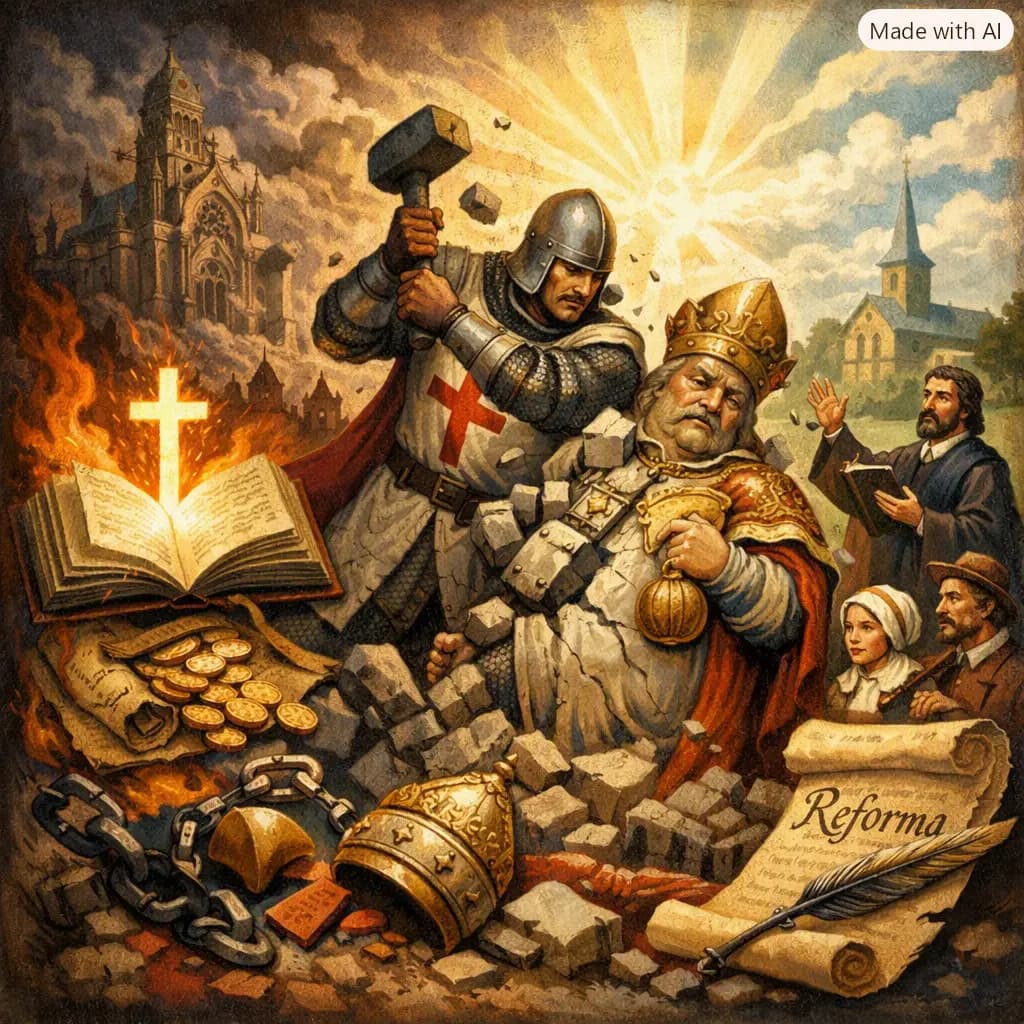
A period in European history marked by efforts to reform the Christian Church
A retelling of Durant's opening of the Burgundy chapter: the four Valois dukes who built a rich, independent state, the splendor and license of their courts, and the contrasting mystics of the Netherlands, Gerard Groote's Brethren of the Common Life, and the book Imitation of Christ.
A retelling of Durant's account of the Burgundian Low Countries at their height: ducal patronage of letters, the great civic Gothic buildings, Claus Sluter's sculpture at Champmol, the rise of oil painting, the Van Eycks' Adoration of the Lamb, and Rogier van der Weyden.
A retelling of Durant's account of the last Valois duke of Burgundy: his ambition to unite his scattered lands into a kingdom between France and Germany, the sack of Dinant and Liège, the war against Louis XI and the Swiss, and his death at Nancy in 1477.
A retelling of Durant's closing section on Burgundy: the economic shift from Bruges to Antwerp, the second generation of Flemish painters from Dirk Bouts to Jan Gossart, the strange world of Hieronymus Bosch, and how Mary of Burgundy's marriage brought the Netherlands into the Habsburg empire.
A retelling of the opening of Durant's chapter on Central Europe: the struggle with forest, sea and mountain, the Black Death, mining and metalworking, the decline of the Hanseatic League, serfdom and class conflict, Margaret's Kalmar Union, and the rise of the Swiss cantons.
A retelling of Durant's account of how the German Empire, a loose federation of princes and free cities, fought the Avignon papacy: the quarrel of Louis of Bavaria with John XXII, the ideas of Marsilius and Ockham, the Golden Bull of Charles IV, and the rise of the Habsburgs.
A retelling of two sections of Durant's chapter on Central Europe: the seeds of the Reformation, the pantheistic mysticism of Meister Eckhart and his disciples Suso and Tauler, and the late Gothic churches, town halls, crafts, Mastersingers and early painters of German cities.
A retelling of Durant's section on Gutenberg: why the Middle Ages ended, the scarcity of manuscripts, paper and printing in China, Korea and Holland, Gutenberg's life and press at Mainz, the rapid spread of printing across Europe, and its effects on learning, religion and literature.
A retelling of Durant's Slavic chapter, opening with the Slavs' emergence and Bohemia under John of Luxembourg, Charles IV and Wenceslaus IV, then the life, teaching, trial and burning of the reformer Jan Hus at Constance, and the death of Jerome of Prague.
A retelling of Durant's account of the Hussite revolution: the national reaction to Hus's burning, the Four Articles of Prague, Jan Žižka's victories, the clash between moderate Utraquists and communist Taborites, the Compacts of Basel, King George of Poděbrady, and the Unity of the Brethren.
A retelling of Durant's section on Poland: the reunification under Ladislas the Short and Casimir the Great, the union with Lithuania through Jadwiga and Jagiełło, victory over the Teutonic Order at Grunwald, and the flowering of Kraków under Casimir IV, including Veit Stoss's art.
A retelling of Durant's opening to the Ottoman chapter: the shrunken Palaiologan empire, class tension and the Zealot revolt at Salonica, the late Byzantine revival of learning under Metochites and Gemistus Plethon, the art of Chora, Mistra and Mount Athos, and the emperors' fatal dependence on the Turks.
