A period in European history marked by efforts to reform the Christian Church
A retelling of the closing section of Durant's chapter on Germany before Luther: the popular piety of Germans, forerunners such as John of Wesel and Wessel Gansfort, the reformed orders and the Augustinians, the Church as the greatest landowner, complaints against Roman taxation, the struggle of Archbishop Dietrich of Mainz with Pius II, the emperor Maximilian's grievances, and the many causes that together made the Reformation.
A retelling of Durant's opening section on Luther: Pope Leo X and the indulgence meant to fund St. Peter's, the bargains with princes, Archbishop Albrecht of Mainz and the Fugger bank, the preaching of the Dominican John Tetzel, Frederick the Wise's relics, and Luther's Ninety-Five Theses posted at Wittenberg on October 31, 1517.
Durant's account of how an obscure monk came to lead a religious revolution: Luther's strict childhood in Mansfeld, his schooling at Magdeburg, Eisenach and Erfurt, the thunderstorm of 1505 and his entry into the Augustinian monastery, the discovery of justification by faith, his years as a Wittenberg professor, his visit to Rome in 1510, and his growing break with Church teaching before 1517.
Durant's account of the two years after the Ninety-Five Theses: the uproar in Germany, Luther's Resolutions and Pope Leo X's summons, the German Diet's protest, the meeting with Cardinal Cajetan at Augsburg, Miltitz's truce and Tetzel's fall, the arrival of Melanchthon and Karlstadt, the 1519 Leipzig Debate with Johann Eck, and the support of Hutten and Sickingen as Luther moves toward open break.
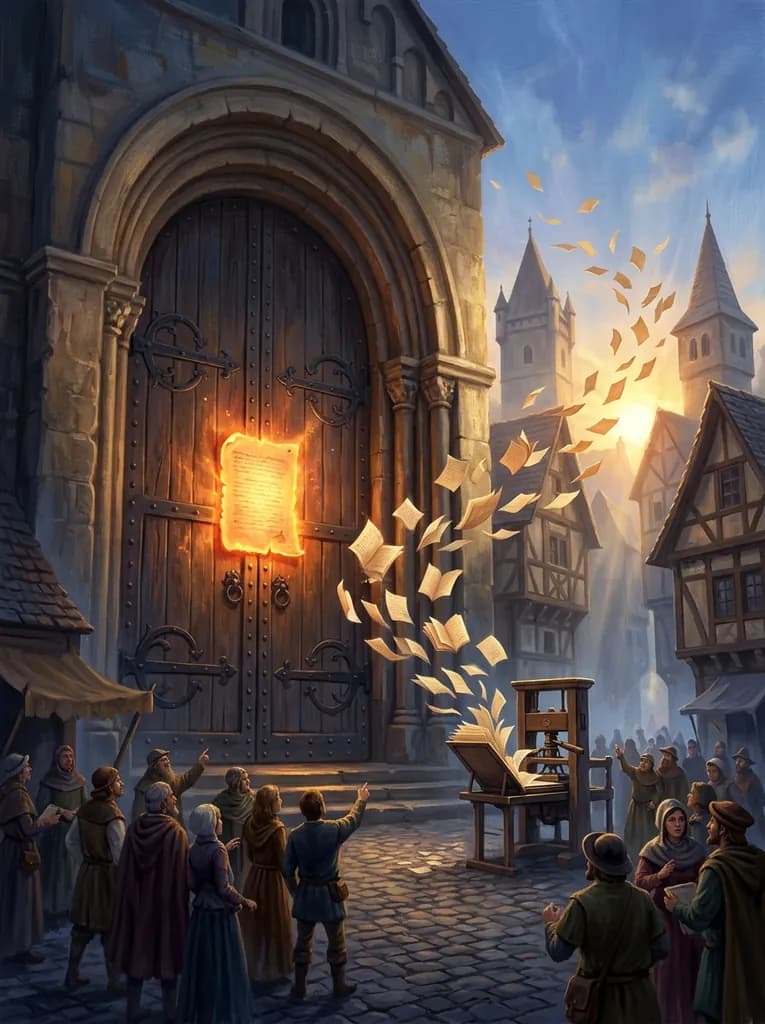
Durant on the climax of 1520: Pope Leo X's bull condemning Luther, the three great reformation treatises (Address to the Christian Nobility, The Babylonian Captivity of the Church, On the Freedom of a Christian), Luther's letter to the pope, the reception of the bull across Germany, and Luther's burning of the bull at Wittenberg on December 10, 1520.
Durant's account of Luther's trial at Worms: the young emperor Charles V and the Fugger loans that put him on the throne, the political reasons for caution, the mood of Germany, Luther's journey and his two appearances before the Diet on April 17 and 18, 1521, the emperor's reply, the Edict of Worms, and Frederick the Wise's plan to hide Luther at the Wartburg.
Durant on the ten months of Luther's hiding at the Wartburg (1521–22), his doubts and his translation of the New Testament, the radical turn of the Reformation in Erfurt and Wittenberg under Karlstadt and the Zwickau prophets, Luther's Sincere Admonition against revolt, and his dramatic return and eight sermons that restored order in March 1522.
Durant on Luther as a working priest and professor, the fighting style of his German prose, how he turned the printing press into a weapon, his German Bible and its effect on language and nation, and his views on Scripture, tradition, reason and the books of the Bible he valued least.
Durant's analysis of Luther's theology: its medieval roots and kinship with Hus and Wycliffe, the stern God of the prophets, the devil and demons in Luther's world, human depravity, justification by faith alone, the doctrine of the bondage of the will, the priesthood of all believers, his reduction of the sacraments, and how Lutheranism shifted power from Church to state.
Durant's closing section on Luther in chapter sixteen: his fierce tract against the bishops in 1522, his treatise on temporal authority and the limits of obedience, the warning he gave the princes, the medieval and conservative side of his economic ideas, and his attack on usury, monopolies and the Fugger trade, written on the eve of the Peasants' War.
Durant on the first stage of social revolution in Germany: the Knights' Revolt and the death of Franz von Sickingen, the spread of Lutheranism among priests, cities and princes, Pope Adrian VI's frank admission of church corruption, the Diet of Nuremberg's hundred grievances, the debate over monopolies and the Fuggers, and Cardinal Campeggio's failed mission in 1524.
Durant on the greatest social upheaval of Reformation Germany: how Scripture and radical preaching inflamed the peasants, Thomas Müntzer and Mühlhausen, the Twelve Articles of Memmingen, Luther's two conflicting tracts, the risings across Germany, the massacres at Frankenhausen and in Alsace, and the war's cost to peasants, humanism and the Reformation itself.
