Revisiting Epochs and Ideologies

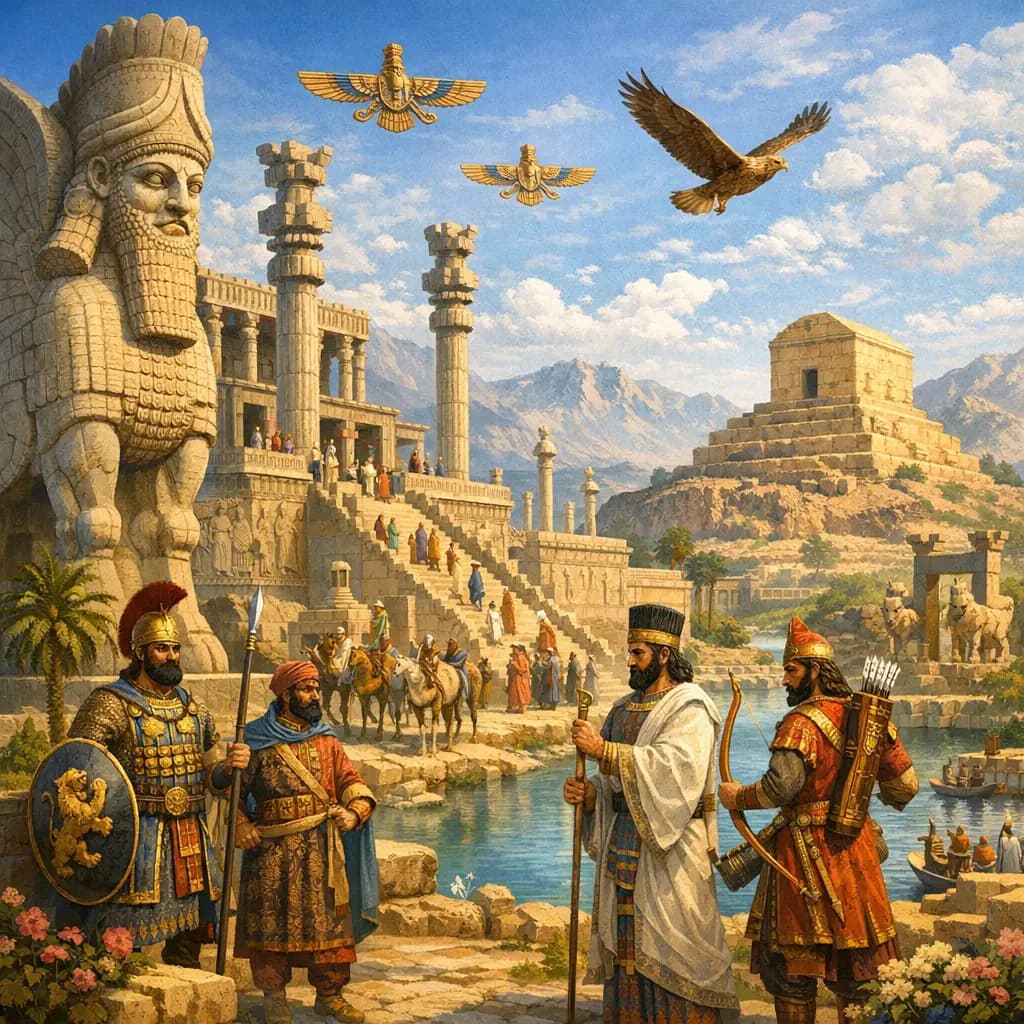
The Iranian peoples known as Pars, Parthia, and Media were three foundational branches of the Indo‑Iranian migrations that settled across the Iranian Plateau during the first millennium BCE. Each group established a major political structure—Median, Achaemenid, and Arsacid—that shaped the political, linguistic, and cultural identity of ancient Iran. This article provides a comparative overview of their origins, territories, political systems, and historical roles.
Jamshid—known in the Avesta as Yima or Yima Xšaēta—is one of the most influential mythological figures in Iranian tradition. His story spans ancient Indo‑Iranian mythology, Zoroastrian cosmology, and later Persian epic literature. This article explores his origins, his role in the Avesta, the myth of the Vara, his transformation in the Shahnameh, and the cultural symbolism associated with him.
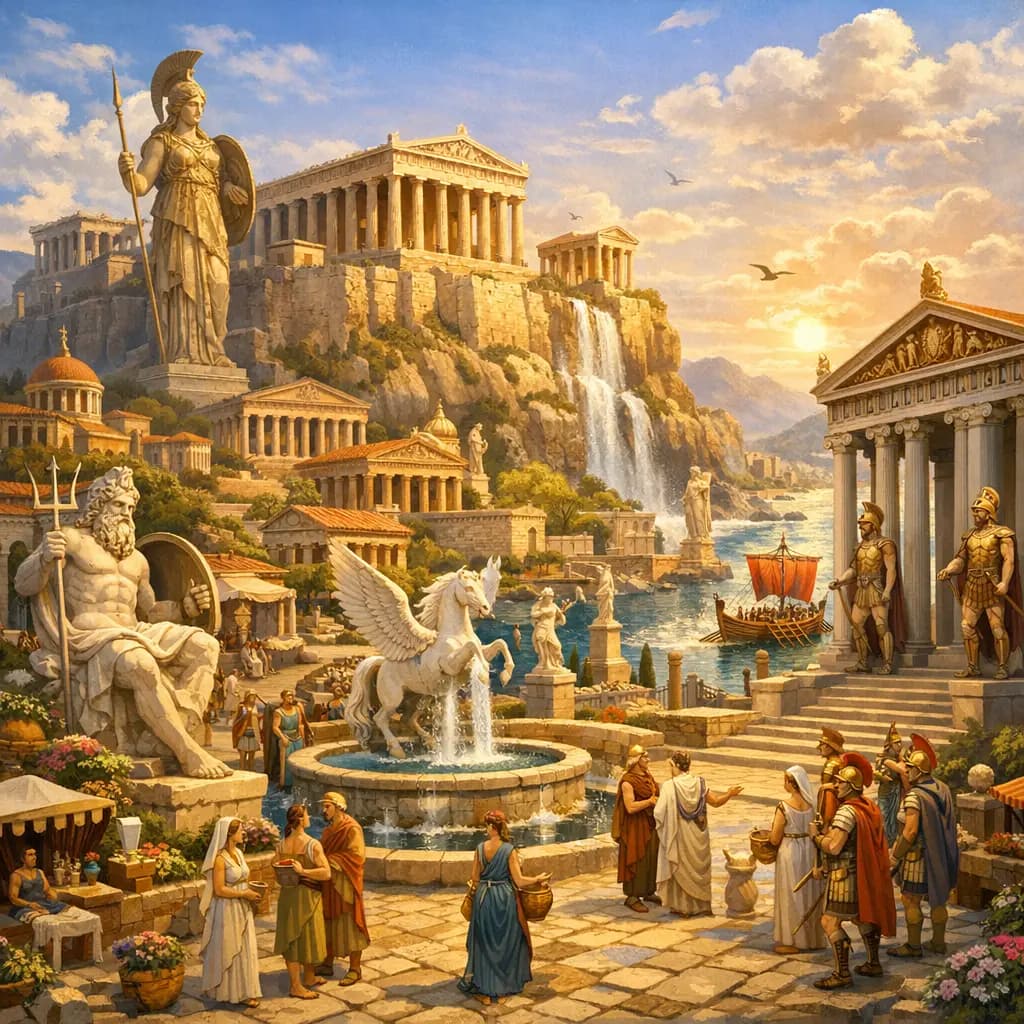
Greece emerged in a landscape shaped by mountains, narrow coastal plains, and a fragmented archipelago that encouraged seafaring, trade, and cultural exchange. The combination of limited arable land, proximity to the Mediterranean Sea, and interaction with older civilizations such as Egypt and Mesopotamia helped transform the Greek world into one of the most influential centers of ancient culture. This article examines the geography, early settlements, maritime traditions, and cultural development that defined ancient Greece.
The Minoan civilization on the island of Crete was one of the earliest maritime cultures of the Mediterranean, known for its advanced urban planning, multi‑story architecture, diverse industries, and extensive trade networks. The city of Knossos, the political and economic center of this civilization, represents a remarkable example of early urban organization, craftsmanship, and social life during the second millennium BCE. This article examines the urban structure, architecture, industries, arts, and athletic traditions of the Minoans based on archaeological discoveries.
The Mycenaean civilization, which flourished on the Greek mainland during the Late Bronze Age, represents one of the most influential early cultures of the Aegean world. Archaeological remains, literary echoes in Homeric epics, and material evidence from palaces, tombs, and workshops reveal a society shaped by warfare, craftsmanship, trade, and complex religious traditions. This article examines Mycenaean economy, art, burial customs, metallurgy, and the cultural transition that followed the collapse of their palatial centers.
Heroic Myths of Ancient Greece and Their Historical Influence
The Homeric Age, spanning roughly from 1300 to 1100 BCE, represents a transitional period between the collapse of the Mycenaean civilization and the rise of classical Greek city-states. The primary sources for understanding this era are Homer’s epics, the Iliad and the Odyssey, which depict a society shaped by warrior aristocracy, household-based social structures, agricultural economy, and deeply rooted cultural values such as honor, hospitality, and loyalty. Although partly mythical, these narratives reflect real social patterns and daily practices of early Greek communities.
The Trojan War, one of the most iconic events in Greek mythology, is primarily known through Homer’s Iliad and Odyssey. For centuries, scholars have debated whether this war was a purely mythical creation or a reflection of real historical events. Archaeological discoveries at Hisarlık, Hittite texts referring to Wilusa, and Egyptian records suggest that a historical core likely existed, even though later poets expanded and mythologized the narrative. This article examines archaeological evidence, historical documents, possible causes of conflict, and the cultural impact of the Trojan War on the ancient Greek world.
The Odyssey, Homer’s second great epic, recounts the long and perilous return of Odysseus to his homeland, Ithaca, after the Trojan War. While the poem is filled with mythical creatures, divine interventions, and maritime adventures, its emotional core unfolds in Ithaca, where Penelope resists social pressure from numerous suitors and Telemachus searches for his missing father. This article examines the political crisis in Ithaca, Odysseus’s dramatic return and revenge, the restoration of family unity, and the historical background behind these legendary events.
This article explores the geographical extent of ancient Greece, the expansion of Greek colonies across the Mediterranean, and the cultural exchanges between Greeks and neighboring civilizations. From Epirus and Illyria to Egypt, Phoenicia, Lydia, Babylon, and Thrace, Greek settlers created a vast network of cities that preserved Greek language, religion, and culture. The article also examines how interactions with advanced civilizations—especially Egypt, Phoenicia, and Babylon—shaped Greek art, science, philosophy, and political development.
This article examines the geography, social structure, political development, and cultural identity of ancient Sparta, the dominant city-state of Laconia. Surrounded by mountains and protected by natural fortifications, Sparta evolved into a militarized society with a rigid class hierarchy, strict laws attributed to Lycurgus, and a unique educational system known as the agoge. The article also explores Sparta’s expansion into Messenia, the rise of the helot class, the economic foundations of Spartan society, and the role of music, poetry, and collective discipline in shaping Spartan identity.
This article examines the laws attributed to Lycurgus, the legendary reformer of Sparta, and their impact on the formation of a militarized, disciplined, and highly structured society. Although the historical existence of Lycurgus is debated, the reforms associated with his name reshaped Spartan politics, economy, education, and social hierarchy. The article explores the origins of these laws, their content, the political institutions of Sparta, and the moral and military values that defined Spartan identity.