Revisiting Epochs and Ideologies

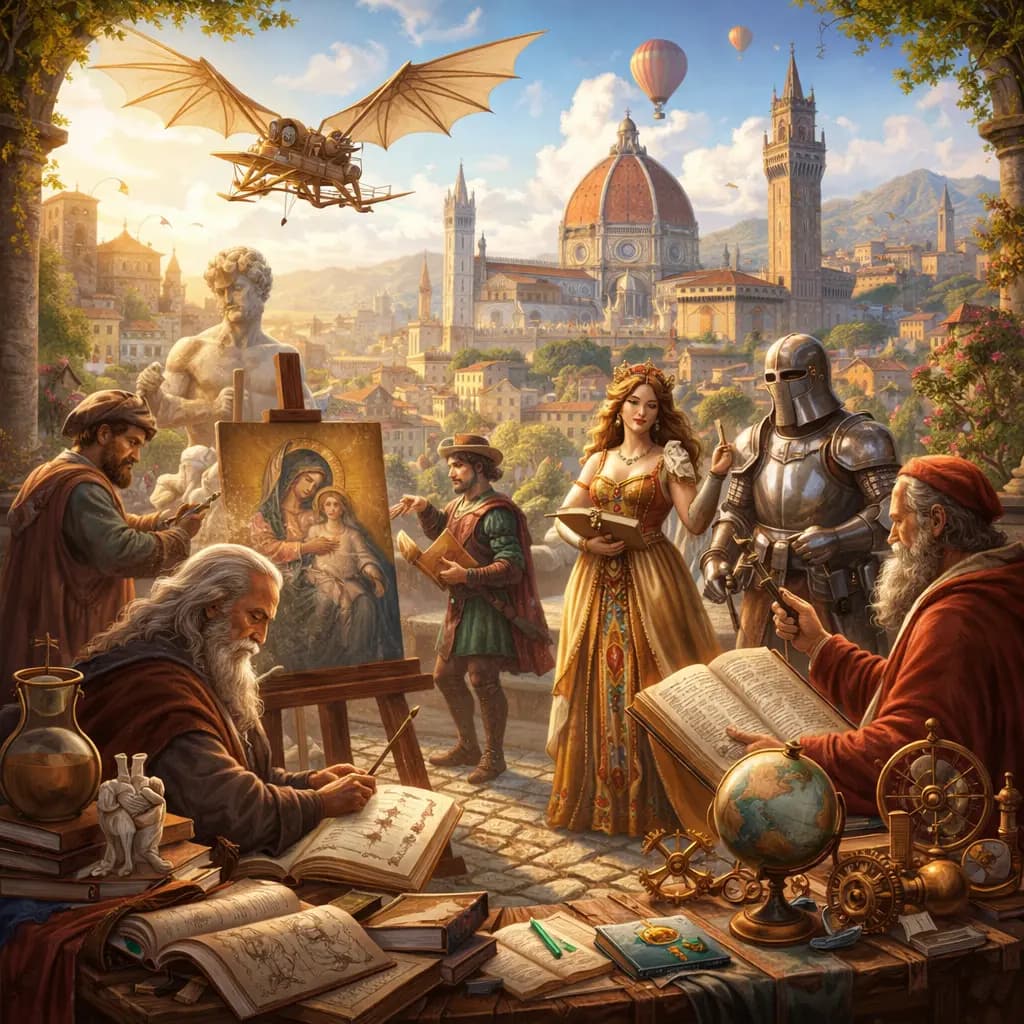
Venice in the late fourteenth century overcame crises with Genoa and Padua to become one of the most powerful states in Italy. This island republic expanded its territory across northeastern Italy, the Dalmatian coast, and Mediterranean islands, amassing enormous wealth. Its intelligent aristocratic government, powerful navy, global trade, and brilliant school of painting turned Venice into the Queen of the Adriatic and one of the major centers of the Renaissance.
Correggio became one of the brightest centers of Renaissance art thanks to the paintings of Antonio Allegri (Correggio). Bologna flourished with its university, churches, and artists. Under the rule of Federico and Guidobaldo della Rovere, Urbino became a symbol of refined culture and courtly elegance. In the south, Naples with Alfonso the Magnanimous’s patronage of humanists, and Sicily with its multicultural heritage, formed part of the rich cultural diversity of Renaissance Italy.
The Great Papal Schism (1378–1417) divided the Catholic Church into two, and later three, rival popes, turning it into a political tool of European powers. The Councils of Pisa, Constance, and Basel attempted to resolve the crisis and establish the supremacy of general councils over the papacy. In the end, Martin V and Eugene IV, with political skill and the support of Emperor Sigismund, ended the schism, but at a heavy cost that severely damaged papal authority.
From the pontificate of Nicholas V to Innocent VIII, Rome was transformed into the center of the Renaissance. The popes rebuilt the city, supported classical literature and art, and strengthened their political power over the Papal States. This era saw efforts to end the schism, wars against the Turks, and internal conflicts, but also led to a flourishing of architecture, painting, and literature that made Rome the heart of Christian civilization and the Renaissance.
The Borgias: Power, Corruption, and the Fall of a Dynasty (1492–1503)
Julius II (Giuliano della Rovere) was one of the most powerful and influential popes of the Renaissance. With a warrior spirit, he reconquered the Papal States, challenged Venice and France, and freed Italy from foreign armies. At the same time, he became the greatest patron of the arts: he forced Michelangelo to paint the Sistine Chapel ceiling, employed Raphael, and began the rebuilding of the new St. Peter’s Basilica. His pontificate marked the peak of the Renaissance’s shift from Florence to Rome.
Leo X (Giovanni de’ Medici), elected pope in 1513, brought the Renaissance to its cultural peak in Rome. With a generous and pleasure-loving nature, he supported artists, scholars, and poets on an unprecedented scale, employing Raphael for the Vatican rooms and Sistine tapestries, while Michelangelo worked on the Sistine ceiling and other projects. Politically, he sought to strengthen the Papal States and the Medici family through diplomacy and war, but his lavish spending and sale of offices contributed to financial strain and the rise of the Protestant Reformation in Germany.
In Renaissance Italy, the intellectual revolt involved a decline in attachment to the other world and a growing interest in this life. People rejoiced in the discovery of a pagan civilization where citizens were not tormented by original sin or hell, and natural impulses were accepted as forgivable elements in a vibrant society. The bonds of tradition and obedience to religious authorities were broken. Yet a price was paid for this freedom of the mind: the supernatural guarantees of morality weakened, and no new principles fully replaced them. The result was the commission of forbidden acts, indulgence of instincts, and a joyful abundance of immorality. Amid this, occult sciences flourished, science and medicine advanced modestly, and philosophy served politics. Guicciardini and Machiavelli offered realistic and pessimistic analyses that separated politics from ethics and longed for the unity of Italy.
Moral laxity in Renaissance Italy stemmed from multiple sources: the weakening of religious faith, the increase in wealth that undermined ascetic ideals, political instability and mercenary wars that eroded social order, and the spread of humanist skepticism. While the upper classes embraced pagan pleasures and individual expression, the lower classes retained more traditional piety. Sexual immorality was common, especially among the clergy and in urban centers, though family life often preserved affection and loyalty. Public morality mixed generosity and charity with corruption, violence, and crime. The period's individualism fostered artistic brilliance but also ethical decline, as supernatural sanctions of morality weakened without new principles fully replacing them. Despite efforts at reform by preachers and some popes, the era ended with Italy devastated by foreign invasions and internal strife.
The period of economic decline and rivalry for the rest of Italy was a golden age for Venice. Despite losing eastern colonies, disruptions in eastern Mediterranean trade, and competition from Portugal, Venice continued to support architects like Sansovino and Palladio, writers such as Aretino, and painters like Titian, Tintoretto, and Veronese. The victory at Lepanto and the rapid restoration of the Doge's Palace after devastating fires demonstrated the Republic's resilient spirit. This era shone with brilliant painting, music, and architecture that elevated Venice as one of Europe's foremost cultural centers.
The Italian Renaissance reached its twilight amid political subjugation by Spain, economic decline from shifting trade routes, and the Catholic Reformation’s tightening grip on thought and morals. Northern Italy lay devastated by foreign armies, while Venice, though diminished commercially, enjoyed a final cultural flowering. Florence submitted to Medici rule under Cosimo I, Rome recovered under Paul III, and smaller states like Parma and Piacenza saw brief revivals. Science and medicine advanced modestly, literature turned toward the novella and vernacular, and art produced giants like Titian, Tintoretto, Veronese, and the aged Michelangelo, whose final works crowned a magnificent era even as political freedom and economic vitality waned.